• ABCMO
  • Board/Bylaws
  • Apply for Certification
    • Application Requirements
    • The Standard Application
    • Special Application on Merit
  • Maintenance of Certification (MOC)
    • MOC Program Requirements
    • Update Your MOC Information
  • Verification of Certification (VOC)
    • Request Primary Source Verification (PSV)
  • News/Archives
  • Contact

American Board of Certification in Medical Optometry

August 22, 2018

The Lewin National Survey of Optometrists

Debate over the findings of the two Lewin Studies issued in 2014 has chiefly centered on Lewin’s prediction of an “adequate supply” of “eye doctors” in its Eye Care Workforce Study: Supply and Demand Projections. The second study, the Lewin National Survey of Optometrists however generated little discussion or comment.

But there was useful information in the Lewin National Survey of Optometrists of such wide scope and sufficient detail to offer accurate insight into how optometrists practiced and viewed their income.

However, for reasons unknown, Lewin choose not to release, but instead obscure, survey findings concerning the types of practices optometrists operated and their degree of dissatisfaction with income while reporting fully the other survey results. Why, one might ask?

The Lewin national survey of optometrists was mailed in 2012 to nearly 4,000 optometrists randomly sampled from 39,580 actively practicing optometrists from whom 726 responses were received. Lewin stated this sample size produced an expected confidence interval above 95% with a margin of error below 5%.

Responding optometrists making up the survey sample were, on average:

    1. 60% male and 40% female
    2. 62% between the ages of 40-65
    3. Race/Ethnicity   
           White   86.0%
           Asian    8.0%
           Black    1.4%

Selected pertinent findings of the Lewin National Survey of Optometrists follow.

Notes of Caution

  1. Lewin did not publish all data it collected. Its survey findings of which of 19 types of practice settings optometrists believed best described their practice was collected but not published. Instead, Lewin only reported two types, the numbers of “self employed” and “employed by others” practices. Failure to report the number practicing at each of the other 17 types of practice settings obscured the degree to which optometry practices have shifted from “private” to “store” settings. (Survey questions #6a and #6b)
  2. Lewin’s “satisfaction survey” was difficult to assess due to its 6 possible response “bubbles” of which only the end ones were labeled (extremely satisfied, extremely unsatisfied) with no middle bubble to signal satisfied. (Survey question #21)

Survey questions #6a, #6b and #21 are shown in detail below.

The National Survey Findings

Survey Question #21

Percentage Satisfied or Extremely Satisfied with:

Scope of Practice/Autonomy          62%
Geographical Location               61%
Job Security                        60%
Career Options/Professional Growth  56%
Inclusion in Medical Plans          36%
New Care Delivery Models            29%
Income/Reimbursement                17%

Lewin states this survey question showed 64% of responding optometrists not satisfied with access to medical plans, 71% not satisfied with new care delivery models and 83% not satisfied with income/reimbursement.

Question #21 contained 6 circles for respondents to indicate varying levels of satisfaction with their income, with “Extremely Satisfied” at the left and “Extremely Unsatisfied” at the right.

     Extremely                         Extremely
     Satisfied                         Unsatisfied
        O      O      O      O      O      O

But the 4 in-between circles were not labeled so it was not clear to responding optometrists what they represented, especially without a “middle circle” to presumably indicate satisfaction. Lewin stated, however, in its summary of findings that “Only 17% of respondents reported that they were satisfied with their income or reimbursement.” So, among the 83% not satisfied with their income there had to be some who were extremely or somewhat unsatisfied or whatever the 4 unlabeled bubbles were supposed to represent.

To be more precise, Lewin should have labeled and reported the percentages for each of the 6 bubbles to show the degrees to which optometrists were unsatisfied with their income rather than stating 83% were unsatisfied.

There is an important difference between finding 83% were not satisfied with their income and a finding that 83% were extremely less than satisfied. All we can deduce from Lewin’s failure to label the circles and show their percentages is that 83% were a little, some, or extremely unsatisfied with their income while only 17% were satisfied some, a little or extremely satisfied with income.

Survey Questions #6a, #6b

Principle Practice Settings

It was good to see, both for the first time, a national survey and one asking in detail how optometrists actually practiced in situ rather than asking ambiguous questions.

Lewin asked optometrists to select which of 19 types of practice setting best described where they practiced.

A. Those stating they were “self-employed” could describe their practice as:

  1. Solo owner not affiliated with regional/national (r/n) retail company
  2. Owner, small group not affiliated with r/n retail company
  3. Owner, large group not affiliated with r/n retail company
  4. Solo franchise, affiliated, adjacent to or within a r/n retail company
  5. Group franchise, affiliated, adjacent to or within a r/n retail company
  6. Independent contractor/lessee
  7. Other (specify)

B. Those stating they were “employed by others” could describe their practice as:

  1. Employed by O.D. in private practice
  2. Employed by O.D. owned franchise/affiliated with r/n company
  3. Employed by non-O.D. owned independent franchise
  4. Employed by ophthalmologist
  5. Employed by hospital/clinic/health care facility
  6. Employed by community health center
  7. Employed by HMO
  8. Employed by r/n optical company
  9. Employed by educational institution
  10. Employed by U.S. or local government
  11. Employed by ophthalmic industry
  12. Employed by others (specify)

But Lewin did not report the percentages of each of these 19 practice types.Instead, Lewin only reported that:

  • 30% were employed by others (24% male, 40% female)
  • 70% were self-employed (76% male, 69% female)
  • Older practitioners trended towards self-employment (over age 65, 76% male and 60% female)

Lewin threw away the most accurate information our profession would have ever had on types of settings at which optometrists practice. Why?

Also, Lewin’s sample of just under 400 optometrists came from a combination of three sources; Provider 360, AOA membership lists, and the Provider Enumeration System. But Lewin did not indicate what percentages of its sample were AOA members or if the percentage of AOA members was the same as in the general population of optometrists. That would have been important to know for AOA members practice differently than non-AOA members and only about 50% of practicing optometrists are AOA members.

Age and Gender

Age     <30    30-39   40-49   50-65    >65 
M/F     9/21   75/96   90/72   238/45   68/7 

Entering Enrollment

2011-2012 1,572

(1,800 in 2018)

Race/Ethnicity of Students

White              56.0%
Asian              30.0%
Hispanic/Latino     4.4%
Black               3.0%
Native American     0.4%
Pacific Islander    0.2%
Other               7.0%

Age and Gender Distribution of Self-Employed

At ages under 30, 29% of males were self-employed compared to 11% of females. But, after age 30, the number of self-employed males and females rose steadily until, at age 65+, females were at 100% and males were at 93%.

Age and Gender Distribution of Employed-by-Others

At ages under 30, 89% of males and 71% of females were employed by others. But, after age 30, the numbers of employed-by-others males and females steadily declined until, at age 65+, females were at 0% and males at 7%.

Total Hours of Practice per Week

The overall average was 40.7 hrs/week with very little variation from this value across age, practice type and years of experience except males averaged 42.15 hrs/week while females averaged 38.55 hrs/week.

Number of Practice Sites

Overall, 66% of optometrists practiced at just one site, 26% at two sites, 4.5% at three sites and 2.8% at four sites.

These percentages declined with age of optometrist until, by age 65+, they became 80% at one site, 20% at two sites, and 0% at three and four sites.

Weeks Worked per Year

Mean weeks worked per year was 47 with very little variation from this number across age, gender and type of practice.

Patient Visits per Week and Hour

Average weekly patient visits were 63 per week with an average of 70 for self-employed and 90 for employed by others.

Average patients per hour were 1.80 with 1.89 for male and 1.63 for female optometrists.

Survey Question #9

Excess Capacity

Optometrists were asked how many additional patient visits they could provide per week if fully booked with zero no-shows without adding additional hours, staff or equipment.

Overall, optometrists said they had, on average the capacity to see 19.8 more patients per week which Lewin termed an “excess capacity” of about 32%.

In its other report, the 2014 Eye Care Workforce Study: Supply and Demand Projections, Lewin used this “excess capacity” of optometry “chair time” to replace the shortages of future ophthalmologists it predicted by assuming optometrists provide the same care as ophthalmologists and they would replace all ophthalmology shortages. Using this highly unrealistic assumption, Lewin claimed there was no surplus of optometrists but, instead, an “adequate supply of eye doctors”; a seriously misleading characterization of the Lewin Supply and Demand Projections.

To make this claim, Lewin assumed that 1.36 optometrists provided the same services as one ophthalmologist despite state practice laws that do not permit optometrists to hold the same scopes of practice as ophthalmologists. But Lewin made this assumption so it could consider an “eye doctor” to be either one ophthalmologist or 1.36 optometrists and thereby reduce the surplus of optometrists it found by believing they would fill in for shortages of ophthalmologists.

Revenue by Source

Stand-Alone Vision Plan   27%
Traditional Insurance     17%
Self-Pay                  16%
Medicare                  15%
Medicaid/CHIP             11%
HMO                        4%
Other                     11%

Median Net Income

Overall              $113,000
Self-Employed        $113,000
Employed-by-Others   $104,000
Age       <30       30-39      40-49       50-65        65+
Male    $62,000   $113,000    $138,000    $138,000   $113,000   
Female  $87,000    $87,000    $113,000    $113,000   $100,000

Assessment

While there is much useful “secondary” information in the Lewin national survey of optometrists, the best survey to date, Lewin chose to not publish its detailed findings of how optometrists practiced or completely reveal their degrees of dissatisfaction with their incomes.

1: Questions #6a and #6b. Lewin did not release its detailed findings on the numbers of optometrists practicing at the 17 different types of practice listed in the survey. This data would have been very enlightening since there have long been debates over whether or not optometry “professionalism” has declined since the FTC removed its ban on advertising by health care providers.

It has seemed since then optometry does not wish to make public how optometrists practice. For example, prior surveys have used terms such as “private practice”, “independent practice”, “commercial practice”, “retail practice”, and “self-employed” vs. “employed” which are overlapping and imprecise practice descriptions.

Why Lewin chose to lump its 19 detailed findings into only “self-employed” vs. “employed by others” was not explained by Lewin nor explained by the two “blue ribbon” panels of AOA selected consultants advising Lewin.

For example, using Lewin’s “self-employed” and “employed-by-others” which is the more professional practice setting?

A salaried staff optometrist at the Wilmer Eye Hospital at Johns Hopkins Hospital (employed-by-others) or an optometrist owning and practicing a mall optical boutique (self-employed).

2. Question #21. This same loss of specificity befell Lewin’s summary of how “satisfied” optometrists were with various aspects of their practice.

Why were 4 of the response “bubbles” not labeled and percentages reported?

While it was clear the great majority of optometrists were “less-than-satisfied” with income, Lewin did not report what percent were “less-than-satisfied”, “somewhat satisfied” or “extremely-unsatisfied” with their income (if that is what those un-labeled bubbles meant).

Conclusions

Lewin’s two studies appear to show manipulation and “obscuring” of data involving:

  1. Current and future surpluses of optometrists.
  2. Increases in number of Optometry Schools and Graduates.
  3. Dissatisfaction with practice incomes.
  4. The Lewin Executive Summary claim of an “adequate supply of future “eye doctors”.

It has been failures to address these very issues that is causing increasing concern among practicing and academic optometrists. Being told to wait for the “facts” from the Lewin Group and its “blue ribbon” advisors has not made matters better.

So why were the facts either not addressed properly or ignored? Why did the advisory panels not object?

The two Levin reports were missed opportunities to gather pertinent and factual information important to the health of our profession and our patients.

Comments are welcome and can be sent to editor@abcmo.org for publication under the author's name.

August 22, 2018
Filed Under: Reflections

August 3, 2018

Optometry is Number One – A Tragedy of the Commons

Independent Study finds Optometry graduates face highest school debt burden.

One unfortunate result of the current oversupply of Optometrists is the reduction of income relative to student debt. In other words, Optometrists pay a higher percentage of their income to retire student loans than all the other major professions. In fact, Optometry pays almost twice the percentage as Medicine.

A graph of the major professions and their expected income to student debt ratio

More Information

  • Which Graduate Degrees Deliver More Debt than Income? – This is the original article and source of the graphic above.
  • Degrees of Debt: Which Graduate Degrees Saddle Students with the Most Debt Relative to Income – This is a summary of the original article.
  • 5 Graduate Degrees that Trigger the Worst Student Loan Payments – This is a summary of the original article with the addition of a video about student loans.
  • The Optometry Surplus – A Review and Editorial

The Tragedy

The tragedy of the commons is a term used in social science to describe a situation in a shared-resource system where individual users acting independently according to their own self-interest behave contrary to the common good of all users by depleting or spoiling that resource through their collective action. [Source: Wikipedia]

Comments are welcome and can be sent to editor@abcmo.org for publication under the author's name.

August 3, 2018
Filed Under: Reflections

July 30, 2018

The Optometry Surplus – A Review

Introduction

With the publication of the Review of Optometry feature article “Diploma Deluge” on February 15, 2018, and current graduation rates nearly doubled in the past 15 years while qualified applicants continue to decline and yet three more new optometry schools planning to open (Tusculum, Wingate, Highpoint), it seems time to revisit the two 2014 Lewin Group Reports on eye care manpower and the misinterpretation of those findings by the AOA.

The complete text of the inaccurate press release sent to AOA members in 2014, “Study Finds Eye Care Workforce is Adequate to Meet Projected Demand” is below with comments by Dr. Myers.


Inside Optometry – June 2014 – Emailed to all AOA members (AOA Website)

Study finds eye care workforce is adequate to meet projected demand

The just-completed National Eye Care Workforce Study was designed to help answer critically important questions about how America’s eye health needs will be met over the next decade and beyond.

Jointly launched by the AOA and the Association of Schools and Colleges of Optometry (ASCO), the study is based on the most current survey and health sector data and a computer model developed by the Lewin Group, a firm widely recognized for its health care policy research.

This is the most ambitious, comprehensive and forward-looking study of eye care supply and demand ever undertaken.

“The results clearly point to a supply of eye doctors – optometrists and ophthalmologists – that is adequate to meet the current and future eye health and vision care needs of the American people,” says Steven A. Loomis, O.D., vice president of the AOA. “The study also demonstrates the opportunities for optometry to further expand its role in the delivery of medical eye care services for seniors, working adults and children.”

An “adequate” number of future “eye doctors” means what? Are these “eye doctors” optometrists, ophthalmologists, or a blend of both? What services do these “eye doctors” provide?

In A Nutshell

Lewin’s supply-demand computer model (for the period 2014-2025) initially predicted future shortages of ophthalmologists and continued large surpluses of optometrists. To reduce the optometry surpluses a revised, final model assumed optometrists had the same scope of practice as ophthalmologists and 1.36 surplus optometrists would fill each future ophthalmologist shortage.

Lewin called this final model a “unified eye care marketplace” in which an “eye doctor” was an optometrist, an ophthalmologist or a surplus optometrist filling a vacant ophthalmology position. In this model surplus optometrists filled all future ophthalmologist shortages by providing the same services as ophthalmologists… yet there still remained a considerable optometrist surplus.

The final model made unrealistic assumptions yet the AOA accepted it and spun it into good news claiming there will be adequate “eye doctors” through 2025, which is as far as the model predicted.

Want More Details?

Lewin had initially predicted increasing shortages of ophthalmologists but current and future surpluses of optometrists (called “over capacity or under utilization”). For example, its National Survey of practicing optometrists in 2012 reported the average optometrist could see 32% additional patients without adding staff, equipment, space or office hours. That amount of empty “chair-time” represented a significant surplus.

But Lewin’s final model of a “unified eye care market” with “eye doctors” masked the optometry surpluses by assuming ophthalmologists and optometrists were interchangeable “eye doctors” providing the same services (despite state practice laws), differing only in that 1.36 optometrists were needed to provide the care of one ophthalmologist.

With this unrealistic assumption, future shortages of ophthalmologists were filled by surplus optometrists which somewhat reduced future optometry surpluses.

Lewin’s sleight of hand; turning optometrists and ophthalmologists into “eye doctors” with identical scopes of practice (why did the optometry advisors not object?) was an effort to hide optometry surpluses and ophthalmology shortages.

So, predicting “adequate” numbers of future “eye doctors” rather than a surplus of optometrists, based upon this Lewin computer projection, seems unwise and very misleading.

The Lewin “unified eye care marketplace” assumption that future optometrists will become “eye doctors” with scopes of practice equal to ophthalmologists seems too unrealistic to be believed.

The dictionary definition of “adequate” is “sufficient to satisfy a requirement”. To say an adequate supply of future “eye doctors” will exist mixes up different types of eye care providers having different scopes of practice and hides the true state of future supply Lewin initially predicted – a shortage of ophthalmologists and a large surplus of optometrists. The “eye doctors” the AOA references are a pipe dream.

(AOA press release continues)

Highlights of the study findings include:

There appears to be an adequate supply of eye doctors, optometrists and ophthalmologists, inclusive of projections of new doctors, to meet current and projected demand for eye care services through 2025.

Please see comments above.

(AOA press release continues)

Demographic trends as well as public health and policy factors, including growth and aging of the U.S. population, an increased prevalence of Type 2 diabetes, expansions in health insurance coverage and the designation in Federal law that coverage for eye health and vision care is essential for children are all projected to contribute to an increasing demand for optometric services through 2025.

The Lewin “unified eye market” did include all the above factors that could increase demand for future eye care. Yet even using 1.36 optometrists to replace each ophthalmologist shortage assumed in the Lewin computer model still predicted a large surplus of optometrists. And the current administration is cutting back some of those federal programs.

(AOA press release continues)

The data collected indicates that with increases in productivity, optometrists currently view themselves as able to accommodate much of the expected increase in demand. Responding optometrists reported that they could see an average of 19.8 additional patients per week if completely booked without adding hours to their practice schedule.

Yes, optometrists reported this to the National Survey. This is what Lewin described as the current (2012) optometry underutilization or overcapacity or a 32% “surplus” that Lewin ignored until incorporating it into its final, “unified eye market” model that assumed this optometry surplus would replace ophthalmologists.

(AOA press release continues)

The trend of optometrists to provide an increasing number of medically necessary eye care services correlates closely with projections for an increasing demand for these services, especially among senior citizens and those at risk for Type 2 diabetes.

This is the basis of statements made by the AOA and other “surplus deniers” that optometrists will expand into medical eye care and fill ophthalmology shortages. That the optometry surplus is a golden opportunity do this. But Lewin, in its final computer simulation still computed a surplus of optometrists even if all future optometrists had become ophthalmologists. What are the odds that all states will grant future optometrists the same privileges held by ophthalmologists?

This incredible Lewin assumption that by 2025 a magic wand will have turned optometrists into ophthalmologists is so unlikely I re-read the Lewin Reports several times to be sure I wasn’t imagining it. This assumption is what the AOA bases its statements on, that an “adequate supply” of “eye doctors” will exist in the future while denying an optometry surplus exists because, if it does exist, it’s a good thing as optometrists will be able to fill ophthalmology shortages.

(AOA press release continues)

Jennifer Smythe, O.D., M.S., ASCO president says, “While the study offers a snapshot of the workforce at this moment in time, one of the most important aspects of this project is that the Eye Care Workforce computer model will allow for continued analysis of the eye care market as external factors affecting both supply and demand change or other factors are introduced. Workforce studies often generate as many new questions as they answer, and we can see some intriguing new avenues for investigation as we seek to advance optometry’s ability to meet the demand for services.”

I hope the Lewin “computer model does allow for” adjustments such as the fact optometrists have yet to be converted into ophthalmologists (2025 is now only 7 years away) and there are another three optometry schools planning to open.

(AOA press release continues)

Mitchell T. Munson. O.D., AOA president, says, “Without a doubt, this is the most ambitious, comprehensive and forward-looking study of eye care supply and demand ever undertaken. It fully recognizes both optometrists and ophthalmologists as providers of the eye health and medical services, including diagnosis, treatment and management of an array of diseases and disorders, which will be increasingly needed by Americans in the years to come.”

Yes, it fully recognizes ophthalmologists and optometrists on the basis 1.36 optometrists provide the same treatments as 1.0 ophthalmologist despite the fact state licensing laws do not permit this.

(AOA press release continues)

AOA and ASCO organized the study project for which funding was provided by ophthalmic industry sponsors, including Alcon, Essilor, HOYA Vision Care, Johnson & Johnson Vision Care, Inc., Luxottica, TLC Vision, and Transitions Optical.


Further comments, notes and references

The following individuals were appointed by the AOA to interface with and supervise the work of the Lewin Group.

Workforce Study Project Team

Randolph E Brooks, O.D. (chair); Kevin L. Alexander, O.D., Ph.D.; Mamie Chan, O.D.; Elizabeth Hoppe, O.D., M.P.H.; Dr. P.H.; David I. Rosenstein, D.M.D., M.P.H.; and Jennifer S. Spangler, M.B.A., M.P.H.

Expert Panel Members

Randolph E. Brooks, O.D.; Mark K. Colip, O.D.; Michael Duenas, O.D.; Edwin C. Marshall, O.D., M.P.H.; Jeffrey C. Michaels, O.D.; John C. Whitener, O.D., M.P.H.; Gary L. Robins, CAE; Mort Soroka, Ph.D.; Jennifer S. Spangler, M.B.A.; M.P.H.; Roger Wilson, O.D.; Christopher W. Wroten, O.D.; Robert Zeiss, Ph.D.

Free Copies of AOA Report and Executive Summary

To get all three documents from the National Eye Care Workforce Study go to aoa.org/marketplace.

  • National Eye Care Workforce Study: Supply and Demand Projections Executive Summary
    Digital Copy:
    Members: Included in membership ($0)
    Nonmember charge is $15
  • Report on the 2012 National Eye Care Workforce Survey of Optometrists (Released in 2014)
    Printed Book:
    Members: Included in membership ($0)
    Nonmember charge is $125
  • National Eye Care Workforce Study: Supply and Demand Projections Final report 
    Printed Book:
    Members: Included in membership ($0)
    Nonmember charge is $625

Lewin Group Reputation

Source Watch states “The Lewin Group has a reputation as the ‘go to’ firm for beleaguered organizations in need of reports and research to support controversial positions and issues.” [SourceWatch]. Lewin Group is located inside the I-495 Washington Beltway in Falls Church, Va.


Whose Interests are Being Protected?

By 2000, after studies by the RAND Corp. and Abt. Group predicted future optometry surpluses, concern began growing among practicing optometrists about a future oversupply.

AOA and academic spokesmen had, in the 1960’s, been lobbying for more schools, claiming there was a shortage of optometrists. But those additional schools established from 1973 to about 1990 were endorsed by their state optometry associations citing supporting demographic data (optometrists per capita) and were approved, and funded, by their state legislatures and became part of public university systems. Examples included the University of Alabama College of Optometry in Birmingham, AL, the SUNY State College of Optometry in Manhattan, NY and the Univeristy of Missouri in Saint Louis, MO.

The new schools since 2000 however did not follow that path and arose “sui generis” without legislative or state association approvals or meaningful studies; often at small, private schools in rural areas, or within existing osteopathic schools or even the same metropolitan area as an existing school. There were no public debates and the sponsoring universities initiated them for their own perceived economic potentials.

These new schools cited U.S. Bureau of Labor Statistics reports that optometry was a rapidly growing profession and/or a new school will promote the creation of local jobs and/or relieve a supposed shortage of optometrists in rural areas. Some of these new schools were in “towns” of under 2,000 people and far from population centers having medical centers or pools of potential patients.

Unfortunately those U.S. Bureau of Labor Statistics reports remain highly questionable from being chiefly based on projections from the schools of optometry and the AOA who continue, to this day, to offer overly optimistic projections of the need for future optometrists. But rural professional schools are unlikely to see their graduates practice there; optometrists per capita are already at a record high, and optometrists, the Lewin National Survey found, reported an average empty chair time of 32%. That survey found that many optometrists must practice at two or more sites and the majority were unhappy with their income.

There should be little doubt of an “Optometry Bubble” or optometry surplus similar to those for attorneys, pharmacists, veterinarians, architects, and graduates in non-STEM and many liberal arts degree holders. And, at the same time, student educational debt has reached over 1.5 trillion dollars, exceeding total credit card debt in the nation.

The question one must ask is why our leaders continued to deny the optometry surplus and felt compelled to “misinterpret” the Lewin Reports (and two previous studies).

They supported the Lewin study’s implausible assumption the scope of optometry care is equal to ophthalmologists, but not as efficient (1.36 optometrists equals 1.0 ophthalmologist) in an effort to explain away the optometry surpluses.

Their summary of the Lewin findings shown earlier, “reassures and soothes” readers there will be “adequate numbers of eye care providers in the future”.

Probable Causes of Optometry Surplus Bubble

  1. Overly optimistic projected needs for more future optometrists given the U.S. Bureau of Labor Statistics.
  2. Growth in government guaranteed student loans that remove schools’ risk of non-payment and are “easier” to obtain than in the past.
  3. Continuing optometry school accrediting standards, when compared to dental/medical schools, lack required quantitative standards for numbers and types of patients seen in teaching clinics.
  4. Desire of existing schools to increase the pool of qualified applicants to avoid reduced enrollments (one school anticipated the bubble and reduced enrollment) and to better compete for students by investing in student amenities (which raised tuitions) previously unknown to students.
  5. Concern over declining percentage membership in the AOA as % membership weakens as more optometrists become employed (most independent pharmacies are gone, 5 chains employ 80% of phamacists and AMA membership has fallen from around 85% to 15% as private practices have declined in numbers).
  6. The decision by small private universities, influenced by 1, to expand their student base by opening optometry degree programs, especially universities with osteopathic schools leveraging existing capital investment.
  7. Anticipated future enrollment declines as number of high school and college graduates decline.

Who is to Blame?

The Lewin Group is one of countless “research” groups in and around Washington D.C. where over 25,000 registered trade associations and lobbyists live.

It is no secret “findings” are often generated by these “research” groups to buttress the interests of their clients in influencing legislative matters. When one of these “research” groups is retained it is understood where their client’s interest is centered.

In my personal opinion the Lewin group was “urged” to torture the evidence (perhaps the cause for the one year delay in release) to turn the optometry surplus into a “good thing” by inventing a new type of “eye doctor” … an O.D. able to perform as a 1/1.36 ophthalmologist.

That assumed “lower efficiency” of optometrists helped absorb the optometry surpluses as it took away 1.36 surplus optometrists for each replaced ophthalmologist.

It is my personal opinion Lewin was retained and then “guided” by members of the two aforementioned panels assigned to work with Lewin.

Why Ruin a Profession?

Why would the AOA and ASCO for years after past manpower studies predicting surpluses have continued to deny optometry surpluses?

Why did only one school of optometry reduce its enrollment to maintain entrance standards as numbers of qualified applicants began to be diluted by additional schools and declining college graduate numbers?

Why did the profession continue to supply overly optimistic predictions of future manpower needs to the U.S. Bureau of Labor Statistics?

I believe the “Tragedy of the Commons” explains why and how optometry leadership ended up damaging the schools, its students and our profession by pursuing individual best interests.

The Tragedy of the Commons

Comments are welcome and can be sent to editor@abcmo.org for publication under the author's name.

July 30, 2018
Filed Under: Reflections

July 10, 2018

Letters to the Editor About the Optometry Surplus

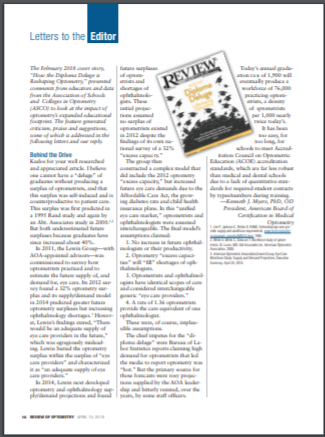
Dr. Myers, President of ABCMO, responds to Review of Optometry’s February 2018 Article: How the Diploma Deluge is Reshaping Optometry.

Published in Review of Optometry, April 2018.

Read the Letter Online Version (Page 14) | PDF Version

Comments are welcome and can be sent to editor@abcmo.org for publication under the author's name.

July 10, 2018
Filed Under: Reflections

July 9, 2018

How the Diploma Deluge is Reshaping Optometry

Review of Optometry

Comments by Dr. Kenneth J. Myers, President American Board of Certification in Medical Optometry

Although in the past decade concerns about the rapidly growing numbers of optometry graduates have been voiced at optometry web discussion boards, schools of optometry and the American Optometric Association continued to claim more graduates were needed. The AOA continued to report to the U.S. Bureau of Labor Statistics that greater numbers of future optometrists were needed…leading the popular media to portray optometry as a “hot” profession that stimulated the opening of more schools, especially at sites with osteopathic schools which were rapidly expanding.

And when the most recent (2014) and “definitive” study of future optometry and ophthalmology supply and demand (Lewin Study – supervised by the AOA) surveyed practicing optometrists and found an optometry overcapacity of 30%, the AOA interpreted this to mean “there would be an adequate supply of eyecare providers in the future”. See AOA Misinterprets Lewin Group Studies for more information.

Optometry appears traveling down the same “Yellow Brick Road” followed by law, veterinarian, pharmacy and other professional schools whose excess graduates carry large student debts and face restricted opportunities to practice their profession.

Meanwhile the ratio of “qualified optometry applicants per seat” has fallen to a record low of nearly one-to-one, the number of licensed optometrists per capita is at record highs and the almost doubled graduation rate of some 1,900 per year will eventually produce about 76,000 licensed optometrists compared to the current 42,000 which is a record number. And the U.S. birth rate has been falling each year since about 1996.

How does optometry growth compare?

Percent growth in degrees conferred 1986-2015 and male/female ratio of graduates in 2015 (Data complied from HEGIS Survey)

Dentistry       +15%,  1.08
Medicine        +15%,  1.09
Podiatry         -6%,  1.58
Chiropractic    -25%,  1.51
Veterinary      +24%,  0.28
Optometry       +47%,  0.50 *

* By 2020 total O.D. degrees conferred will be 85% higher than base year 1986 if enrollments remain at current level.

AOA Misinterprets Lewin Group Studies

Click here to read AOA’s misinterpretation of the Lewin Group Studies. The Lewin Group studies are available for free only to AOA members.

  • Eye Care Workforce Study, The Lewin Group, Inc., March 24, 2014
  • Eye Care Workforce Study: Supply and Demand Projections, The Lewin Group, Inc., April 25, 2014

For independent reviews of the Lewin Group findings please read

  • Review of Optometry: How the Diploma Deluge is Reshaping Optometry
  • Lewin Survey Finds Large Optometry Surpluses: An Editorial Analysis (PDF)

HEGIS Survey

U.S. Dept. of Education, National Center for Education Statistics, HEGIS Survey, Division of Education Statistics, Table 324.50, May, 2017.


Review of Optometry was the first non-academic trade association to investigate the optometry surplus. Bill Kekevian, Senior Editor, takes a look at the issue while focusing on the impact on academic standards.

Read the Full Article Online Version | PDF Version

Comments are welcome and can be sent to editor@abcmo.org for publication under the author's name.

July 9, 2018
Filed Under: Reflections

September 21, 2017

The Future of Optometric Education

In his most recent paper, The Future of Optometric Education – Challenges and Opportunities, Dr. Charles Mullen gives an overview of the major issues faced by optometric education along with recommended actions to address each one. The links below will take you to specific sections in the paper.

Ten Challenges for Optometric Education

  1. Significant Oversupply of Optometrists
  2. Inflated Enrollments and Excess Graduates
  3. High Graduate Debt vs. Potential Income
  4. Static Student Applicant Pool
  5. Impact of Corporate Optometry
  6. Potential Loss of Medicaid Clinic Revenue
  7. VA Threatening to Outsource Optometry Services
  8. Exclusion from Many Key Federal Scholarship and Loan Repayment Programs
  9. Increased Clinical Training Costs with No New Revenue Sources
  10. Exclusion of Optometry from the Graduate Medical Education Program

Comments are welcome and can be sent to editor@abcmo.org for publication under the author's name.

September 21, 2017
Filed Under: Reflections

October 15, 2014

Lewin Study Finds Large Optometry Surpluses

The 2014 Lewin Studies (AOA supervised), the most recent and comprehensive studies to date, found a 30% excess capacity of practicing optometrists for 2012. Two earlier studies had predicted future surpluses (Abt. Associates and RAND Corporation) but were ignored. Since the 2014 Lewin reports graduation rates continued to rise and are now (As of July, 2018) 70% higher than in 1991 (1,900 vs. 1,115). When the Lewin study was conducted the graduation rate was 47% higher than the 1991 benchmark graduation rate.

Despite three prior studies and rapid increase in enrollments, the schools and the AOA continued to state demand for future optometrists was strong to its members and the U.S. Bureau of Labor Statistics.

Lewin Study Finds Large Optometry Surpluses – an Editorial Analysis by Dr. Kenneth J. Myers (PDF)

Comments are welcome and can be sent to editor@abcmo.org for publication under the author's name.

October 15, 2014
Filed Under: Reflections

September 29, 2014

When is Enough Way Too Much?

With a healthcare system in transition, optimistic ODs hope for expansion of our primary care responsibilities. While this is possible and perhaps even likely, the facts — facts supported by every workforce study going back to 1995 — suggest that there are already more than enough ODs to fill increased needs for the foreseeable future.

Charles Mullen (www.charlesmullen.com) recently published a guest editorial by Kenneth Myers that explored the issue in depth. It also examined the 2014 Eye Care Workforce Study conducted by Lewin Associates. Know that Mullen and Myers are among the most important and influential leaders in the modern history of our profession and neither have any axe to grind other than concern for our profession and patients.

In the editorial, Myers notes that since 2006, six new optometry schools have opened and three more are still planned. Since 1985, the number of graduates has increased from slightly over 1,000 to 1,600 this year, with more to come.

Consider all of this against the backdrop of an unstable healthcare environment, crippling student debt, shrinking applicant pools and the likelihood of technology-driven increases in practitioner efficiency. The impact on the profession remains to be seen, but from where I stand, the future is far less bright than it was when I started.

Optometry today is dramatically more advanced than it was in 1985. We owe that to the vision, commitment and tenacity of those who came before us. Likewise, we all share responsibility to those who will come after us. When asked about the future of our profession, honesty is not only the best policy, but it can also be a powerful tool in helping to balance the needs of the profession and our patients.


Off the Cuff: When is Enough Way Too Much? was written by Arthur B. Epstein, OD, FAAO and Chief Medical Editor of Optometric Physician. It was published September 29, 2014.

Comments are welcome and can be sent to editor@abcmo.org for publication under the author's name.

September 29, 2014
Filed Under: Reflections
  • « Previous Page
  • 1
  • 2
  • 3
  • 4
  • 5
  • Next Page »

Email Updates

ABCMO News

  • ACMO Exam Scheduled for Friday, June 5, 2026
  • The Journal of Medical Optometry – First Edition
  • A Reminder to VA Residents
  • Background Information – Article 19 – Maintenance of Certification (MOC)
  • Dr. Charles F. Mullen Joins ABCMO as Special Advisor to the Board

Reflections – Editorials and Articles of Interest

  • Specialization and Subspecialization
  • Ophthalmology Workforce Expected to Decline
  • 10 Administrators for Every Doctor
  • What is Medical Optometry?
  • A Letter to VA Optometry Residency Coordinators: Benefits of ACMO

Comments are welcome and can be sent to editor@abcmo.org for publication under the author's name.

Certification Requirements

The following are in addition to an O.D. degree from an accredited North American school or college of optometry and a current state license to practice.

Residency: Completion of a full-time, ACOE (or equivalent) accredited, postgraduate clinical residency training program having major emphasis on medical optometry.

ACMO Exam: Passage of the Advanced Competence in Medical Optometry exam (or equivalent) offered by the National Board of Examiners in Optometry.

Practice: Documented significant practice of medical optometry for a minimum of two years immediately prior to application for certification.

The Practice requirement is waived in the two years immediately following residency training.

Complete Application and Requirements

Recognized by the American Board of Optometry Specialties

American Board of Optometry Specialties Logo

© 2010-2026 · The American Board of Certification in Medical Optometry · 18683 Milton Ave, Big Rapids, MI 49307
Privacy Policy · Terms of Use · Log in